What Is Direct Democracy?
From the Athenian agora to the digital age — how citizens can govern themselves without intermediaries.
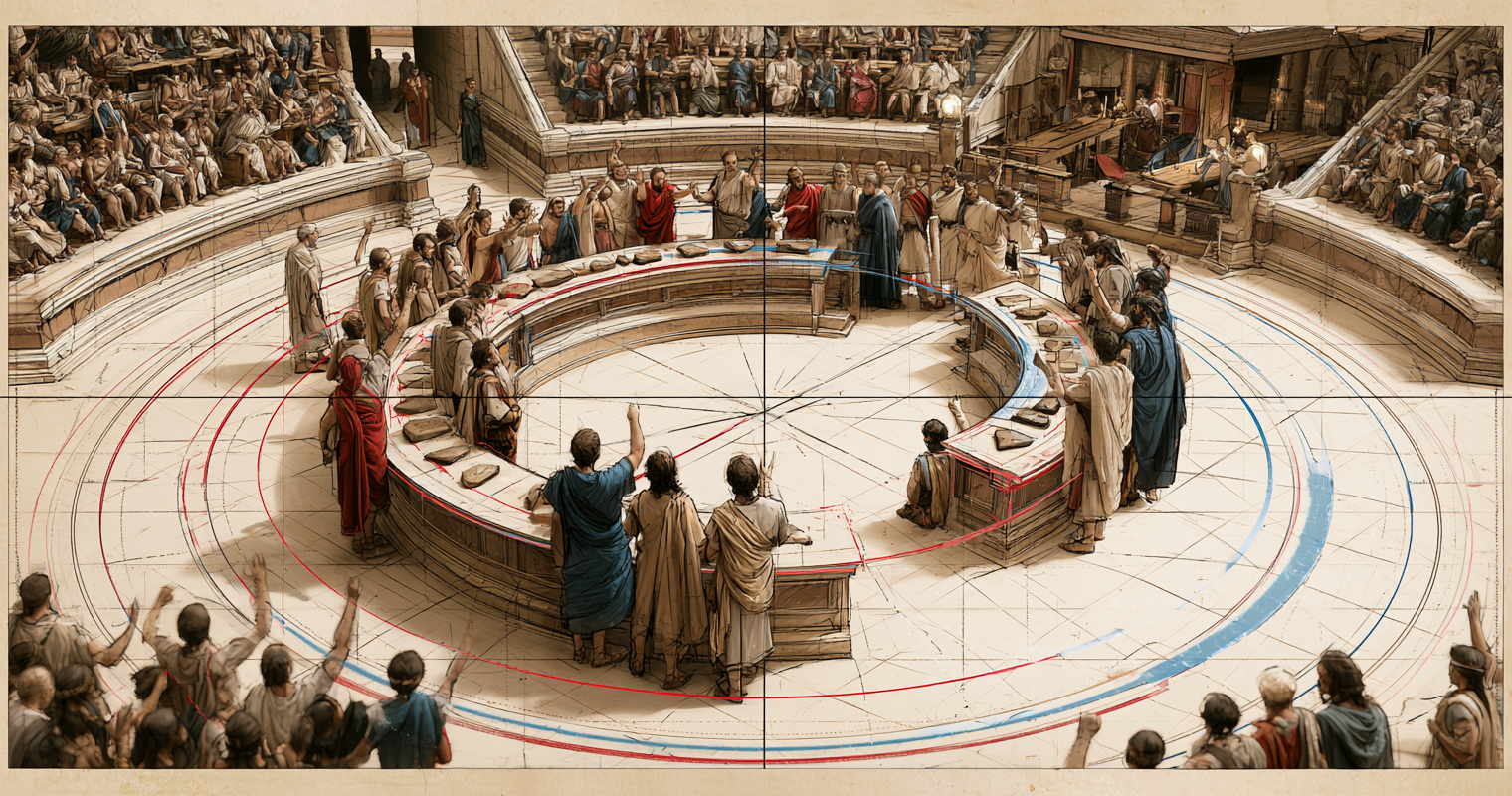
Born in Athens, Built for the People
In 508 BC, an Athenian statesman named Cleisthenes introduced a radical idea: let the citizens govern themselves. No kings. No aristocratic councils making decisions behind closed doors. Instead, every free male citizen of Athens could speak and vote directly on the laws that shaped their lives.
They called it demokratia — "rule by the people." The assembly, or ekklesia, met on a hillside called the Pnyx, where as many as 6,000 citizens would gather to debate war and peace, taxes and treaties, justice and public works. There were no representatives. No intermediaries. If you were a citizen, you were the government.
This was direct democracy in its purest form — and for nearly two centuries, it worked. Athens produced some of history's greatest achievements in philosophy, art, architecture, and science, all under a system where ordinary people made extraordinary decisions.
How Direct Democracy Works
Direct democracy rests on a simple principle: citizens vote on policy directly, rather than electing someone to vote on their behalf. In practice, this takes several forms:
- Referendums — The government puts a specific question to a popular vote. Brexit (2016) is perhaps the most famous modern example.
- Citizen Initiatives — Citizens themselves propose new laws or constitutional amendments by gathering enough signatures. California's proposition system is a prominent example in the United States.
- Recalls — Citizens can vote to remove an elected official before their term ends, as happened with California Governor Gray Davis in 2003.
- Participatory Budgeting — Citizens directly decide how to allocate a portion of public funds, pioneered in Porto Alegre, Brazil in 1989.
Each mechanism gives citizens a direct hand in governance — bypassing the legislature and putting decisions more directly in the hands of the citizens who live with the consequences.
Core Principles
Direct democracy is built on several foundational ideas that distinguish it from other forms of governance:
Political Equality. Every citizen's vote carries the same weight. A farmer's voice is equal to a banker's. A first-generation immigrant who earns citizenship has the same say as someone whose family arrived on the Mayflower. This isn't just idealism — it's the mechanism that prevents concentrated power.
Popular Sovereignty. Legitimate authority flows upward from the people, not downward from institutions. Governments derive their power from the consent of the governed — a principle the American founders enshrined in the Declaration of Independence, even as they chose a representative model for the Constitution.
Transparency. When citizens vote directly, the process is inherently transparent. There's no backroom deal, no committee markup, no conference committee reconciliation. The question is asked; the people answer; the result is public.
Accountability. In a direct democracy, there's no one to blame but ourselves. That's both its greatest strength and its heaviest burden. Citizens must be informed, engaged, and willing to live with the consequences of their collective decisions.
The Criticisms — And Why They Matter
Direct democracy has never been without critics. Even in Athens, philosophers like Plato worried about "mob rule" — the idea that uninformed masses could be swayed by demagogues. The American founders shared this concern. James Madison, in Federalist No. 10, warned about the "tyranny of the majority" and argued for a republic that would filter popular passions through elected representatives.
Modern critics raise additional concerns: Can ordinary citizens understand complex policy? Won't wealthy interests dominate initiative campaigns? Doesn't direct democracy lead to short-term thinking? These are legitimate questions, and honest advocates of direct democracy must grapple with them.
But the digital age has changed the equation. Information is more accessible than ever. Deliberation tools can structure debate. Verification systems can ensure one-person-one-vote integrity. And platforms like Constitution.Vote can show not just what people think, but how different groups think — creating a richer picture than any binary referendum ever could.
Direct Democracy Today
Direct democracy isn't a relic of ancient Athens. Switzerland holds multiple national referendums every year. Over half of U.S. states allow citizen-initiated ballot measures. Iceland crowdsourced its constitutional revision in 2011. Taiwan's digital democracy platform, vTaiwan, has shaped national policy on issues from Uber regulation to alcohol sales.
What's new is the scale and speed that technology enables. For the first time in history, millions of people can deliberate and vote on specific policy questions in real time — not once every two or four years, but every single day. That's what Constitution.Vote is building: not a replacement for representative government, but a permanent, transparent signal of what the American people actually want.
The question is no longer whether direct democracy is possible at scale. The question is whether and how these tools should complement the institutions we already have.
Ready to make your voice heard?
Join the people's assembly and vote on the issues that matter. Your voice, verified and counted.
Continue Reading
Representative vs. Direct Democracy
Two visions of self-governance — and why the best system might be both.
Modern ContextDigital Democracy: From Athens to the Internet
Twenty-five centuries of democratic innovation — and why the next leap is happening now.
How It WorksHow Constitution.Vote Works
The complete guide to the people's assembly — from your first vote to shaping national consensus.