Digital Democracy: From Athens to the Internet
Twenty-five centuries of democratic innovation — and why the next leap is happening now.
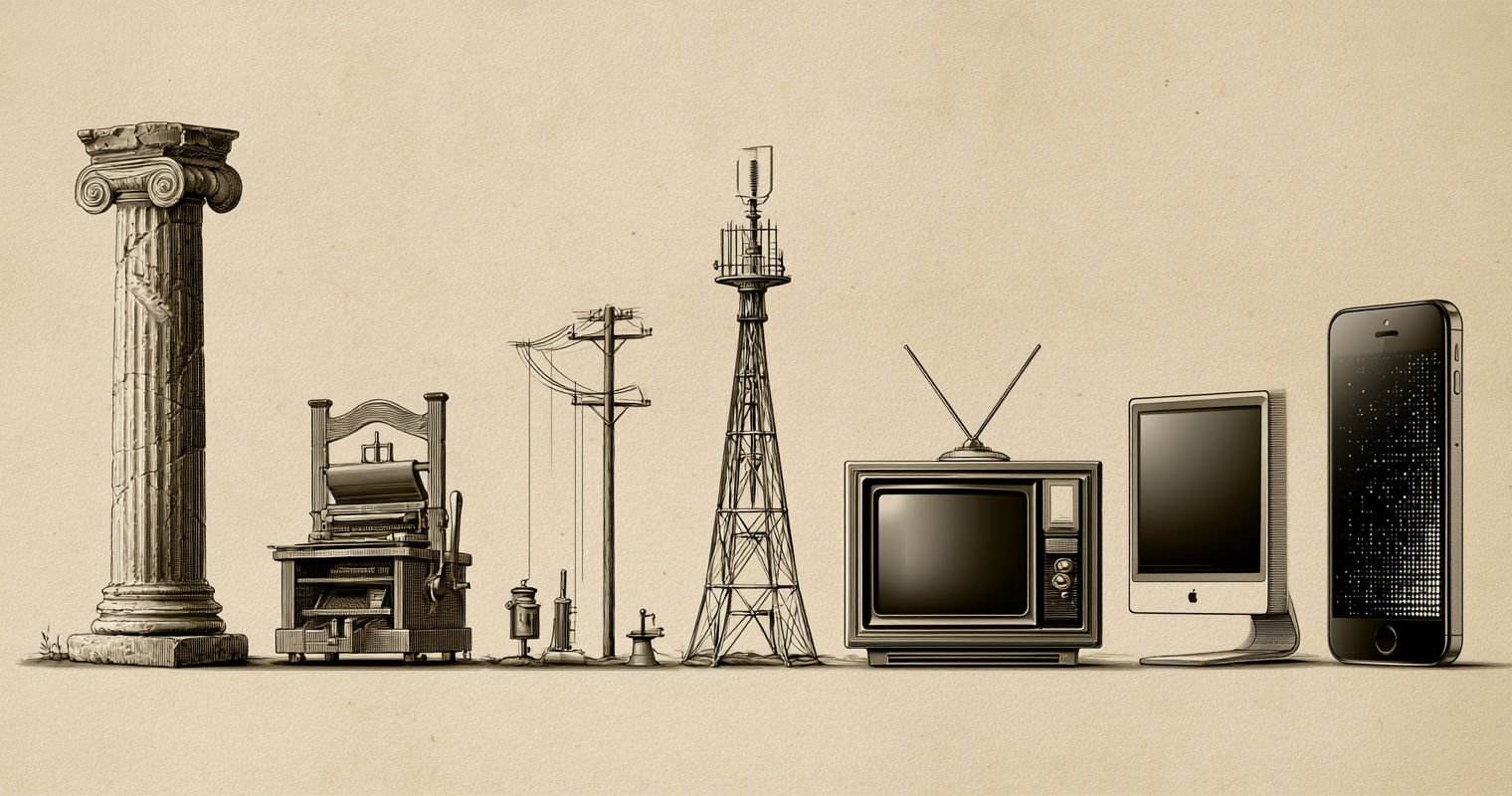
Athens: Democracy by Walking Distance
Athenian democracy was limited by geography. You had to physically walk to the Pnyx to participate. This meant democracy was possible only at the scale of a city-state — maybe 30,000 eligible citizens. Anything larger was unimaginable. How could you deliberate with people you couldn't see, hear, or shout down?
For two thousand years after Athens fell, this geographic constraint made direct democracy seem permanently impossible at the scale of a nation. Republics — with elected representatives who could travel to a central capital — were the only viable model for large states.
The Printing Press: Ideas at Scale
Gutenberg's printing press (c. 1440) didn't create democracy, but it made the democratic revolutions possible. For the first time, political ideas could spread faster than a person could walk. Martin Luther's Ninety-Five Theses went viral in 1517. Thomas Paine's Common Sense sold 500,000 copies in 1776 — in a country of 2.5 million people.
The Federalist Papers themselves were a product of print technology — newspaper essays designed to persuade a mass audience. Without the printing press, there's no informed citizenry, no public debate, and no democratic revolution. The technology of communication has always been the technology of democracy.
Radio, Television, and the Broadcast Era
Radio brought political voices into living rooms. FDR's fireside chats (1933–1944) demonstrated that a leader could speak directly to millions of citizens simultaneously — bypassing newspapers, legislatures, and intermediaries. For the first time, democratic communication was real-time and emotional, not delayed and textual.
Television amplified this further. The Kennedy-Nixon debate of 1960 showed that how you looked mattered as much as what you said. TV made politics more accessible but also more performative. It democratized information while centralizing the power to frame it in the hands of a few networks.
The broadcast era's democratic contribution was awareness — more people knew more about what their government was doing than at any previous point in history. Its democratic limitation was that communication was one-directional. Citizens could watch and listen, but they couldn't talk back.
The Internet: Everyone Has a Voice
The internet made communication bidirectional and democratic. Blogs let anyone publish. Social media let anyone build an audience. Online petitions let anyone organize. For the first time since Athens, every citizen could potentially participate in political discourse — not just consume it.
But the internet also created new problems. Social media algorithms optimized for engagement, not deliberation. Misinformation spread faster than fact-checks. Filter bubbles isolated people into ideological echo chambers. The promise of digital democracy was real, but the implementation was chaotic.
What was missing was structure. The internet gave everyone a voice but no mechanism for that voice to be measured, verified, and aggregated into a coherent signal. A million tweets don't constitute a vote. A trending hashtag isn't a mandate. The technology for expression existed, but the technology for democratic decision-making didn't — until now.
The Next Leap: Structured Digital Democracy
The current generation of civic technology goes beyond expression to decision-making. Platforms like Constitution.Vote don't just let you state your opinion — they structure it, verify it, aggregate it, and display it in ways that are transparent, accountable, and impossible to ignore.
Identity verification ensures one-person-one-vote integrity. Party structures provide community and context. Real-time visualization makes consensus visible. Historical archives track how opinion evolves. Geographic breakdowns show how every county thinks.
This is the leap the Athenians would have made if they'd had the technology: democracy that works at the scale of a nation, in real time, with the rigor of a structured system and the openness of a public square. Twenty-five centuries after Cleisthenes, the tools have finally caught up to the idea.
Ready to make your voice heard?
Join the people's assembly and vote on the issues that matter. Your voice, verified and counted.
Continue Reading
What Is Direct Democracy?
From the Athenian agora to the digital age — how citizens can govern themselves without intermediaries.
Modern ContextCivic Technology & the Future of Governance
The tools are ready. The question is whether we are.
Modern ContextHow Other Countries Do Direct Democracy
Switzerland, Iceland, Estonia, Taiwan, Brazil — lessons from nations that let their people decide.