The Case for a People's Assembly
What if the people had their own congress — not to pass laws, but to make their will undeniable?
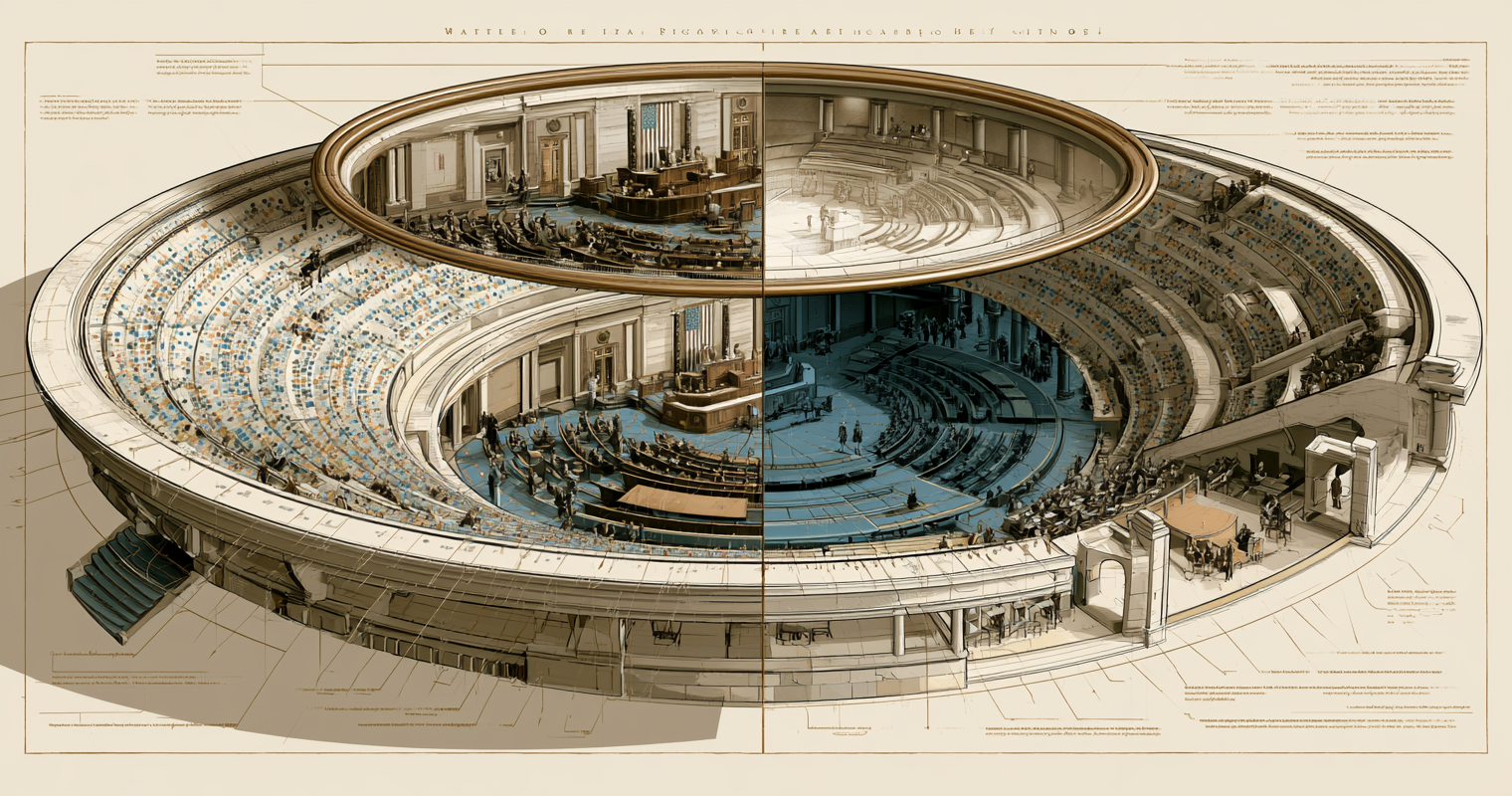
A Congress of the People
Imagine a parallel congress — one with no legal authority but total moral authority. A body where seats are allocated not by geographic districts but by what Americans actually believe. Where every issue gets a vote, not just the ones that party leaders allow to reach the floor. Where the results are public, transparent, and updated in real time.
This isn't a fantasy. It's what Constitution.Vote is building. The Citizens' Assembly is a living visualization of what American representation would look like if it actually reflected the people. It's not meant to replace Congress — it's meant to be a mirror that shows Congress what it should look like.
Historical Precedents
The idea of a shadow assembly has deep roots. During the American Revolution, colonial assemblies operated as parallel governments before independence was declared. The Irish Dáil Éireann first met in 1919 as an unofficial parliament while Ireland was still under British rule — and eventually became the real one. South Africa's African National Congress operated as a shadow government during apartheid, developing policy positions and governance capacity decades before coming to power.
More recently, citizens' assemblies have been used in Ireland (2016–2018) to deliberate on constitutional questions including abortion and marriage equality. These assemblies — composed of randomly selected citizens — produced recommendations that ultimately led to successful referendums and constitutional change.
The pattern is clear: when citizens feel the official system doesn't fully represent them, parallel institutions emerge to fill the gap. The Tea Party movement of 2009–2010 demonstrated the same impulse within the existing party system — organized citizen pressure reshaping congressional priorities from the outside. Constitution.Vote's Citizens' Assembly is the digital version of this ancient democratic impulse.
The Power of Visible Consensus
The people's assembly doesn't need legal authority to be powerful. Its power comes from visibility. When 75% of verified users across all major parties support a policy that Congress refuses to act on, that gap is documented, public, and permanent. No representative can claim they didn't know what their constituents wanted.
Visibility creates accountability. Every issue has a paper trail. Every party's position is on record. Every representative's alignment (or misalignment) with their constituents is measurable. The assembly turns vague claims about "the will of the people" into hard data — data that journalists, researchers, activists, and voters can use to hold power accountable.
This is why the parliament visualization matters so much. It's not decoration — it's a statement. It says: this is what America's representation should look like. Compare it to what you have. The difference is the measure of the representation gap.
From Shadow to Substance
Every real institution started as an idea. The Continental Congress was a group of colonial delegates with no legal standing until they declared independence. The United Nations was a wartime alliance before it was an organization. The internet was a military research project before it was the backbone of global commerce.
Constitution.Vote's assembly starts as a visualization — a beautiful, data-driven picture of what democratic representation could be. But as the user base grows, as the data accumulates, and as the results prove reliable, the assembly gains authority. Not legal authority — something more durable. Moral authority. Evidentiary authority. The authority that comes from being the only institution in America that can prove, with data, what the people actually want.
That's the path from shadow to substance. Not through revolution, but through relentless, transparent, verified expression of the people's will. When millions speak clearly and consistently enough, their voice becomes impossible to ignore — and the shadow becomes the standard against which all representation is measured.
Ready to make your voice heard?
Join the people's assembly and vote on the issues that matter. Your voice, verified and counted.
Continue Reading
Why Your Voice Is Missing from Washington
The representation gap is real, measurable, and getting worse. Here's what the data says.
How It WorksHow Constitution.Vote Works
The complete guide to the people's assembly — from your first vote to shaping national consensus.
Civic FoundationsRepresentative vs. Direct Democracy
Two visions of self-governance — and why the best system might be both.