Why We Built This
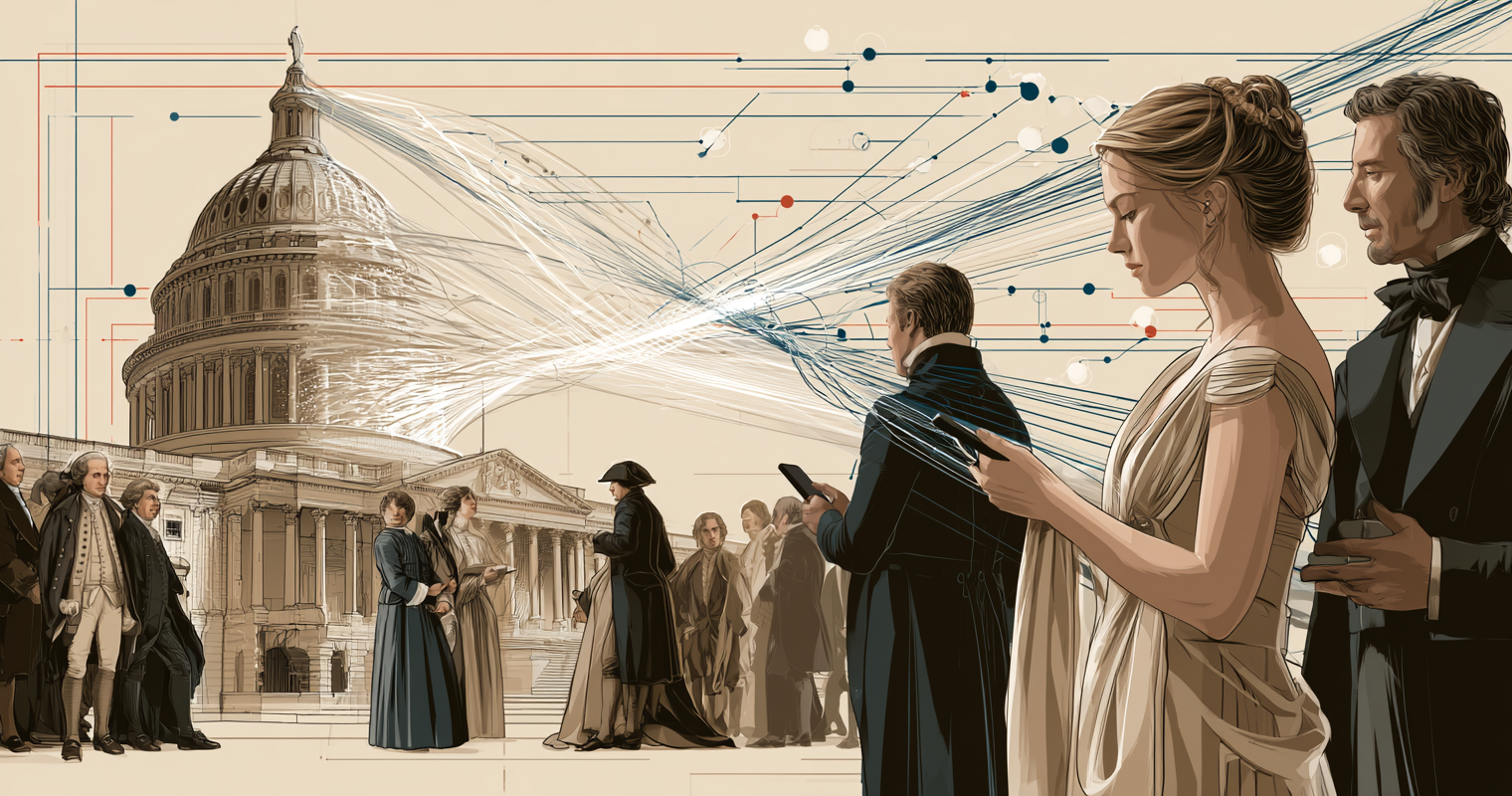
535 people sitting in a building in Washington is an 18th-century workaround for a problem that technology solved decades ago. It's time to finish what the founders started.
It Starts with a Simple Question
What do Americans actually think?
Ignore the pundits. Set aside the polling samples, the campaign rhetoric, the cable news cycle. Strip it all away and ask the raw question: what do 330 million people believe about the issues that govern their lives?
Constitution.Vote exists to answer that. Citizens vote on policy issues every day. They organize into parties that match what they believe. They see the results in real time, unfiltered and unmediated. The signal.
That's the beginning. Benign by design. We hold up a mirror. We show the country to itself.
Here's what makes the mirror dangerous to the status quo: at scale, it becomes undeniable. Once you can see what the people want, with party breakdowns and county-level granularity and cryptographic verification, it gets very hard for anyone to pretend they don't know.
Why 535 People in a Building Is an Anachronism
Congress was designed in 1787. The fastest information transfer available was a man on a horse. The fastest way to deliberate was a room full of people talking. The founders built the most sophisticated democratic machinery their technology allowed: elect local representatives, ship them to Philadelphia, have them argue and vote on everyone's behalf.
Brilliant, given the constraints. The compromise was logistical, not philosophical. You couldn't poll 4 million citizens on every issue. You couldn't tally their preferences in real time or verify their identities at a distance. Proxies were the only option.
But the founders never called this the ideal system. They called it the best they could do right now. They built in an amendment process because they expected future generations to have better tools. Franklin was a scientist. Jefferson was obsessed with technology. These men wrote the postal service into Article I, Section 8, because they grasped a principle we've somehow forgotten: democracy requires communication infrastructure.
If they had fiber optics, they would have used fiber optics. If they had cryptographic identity verification, they would have used that too. The real question is whether they would approve of us sitting on tools they would have killed for and choosing to ignore them.
Capture Is Physics, Not Conspiracy
Every intermediary in a communication channel introduces noise. Claude Shannon proved this in 1948. A signal transmitted through relays loses fidelity at each stage. More relays, more noise. More noise, less of the original message gets through.
American democracy is a communication channel. Citizens want things. Government does things. Between those two endpoints stand representatives, committees, party leaders, lobbyists, donors, media narratives, gerrymandered districts, primary electorates, and institutional inertia.
When you measure the channel using Gilens's dataset of 1,836 policy questions and Shannon's equations, the result lands like a verdict: 0.025 bits out of a theoretical maximum of 0.934 bits. The democratic channel operates at 2.7% of capacity. The remaining 97.3% is noise.
This has nothing to do with corruption in the dramatic, criminal sense. The system fails without villains. It fails because an architecture designed for horses and handwritten letters cannot transmit a 21st-century signal. The building in Washington is where the signal degrades.
Every Other Domain Evolved. Governance Didn't.
Look at what happened to every other complex information system since 1787:
- Finance: Counting houses became algorithmic trading executing millions of transactions per second. A stock price now aggregates the judgment of millions of participants, updated continuously.
- Medicine: Leeches became genomic sequencing. Diagnosis draws on databases of millions of cases to find patterns invisible to any individual doctor.
- Logistics: Clipper ships became real-time global supply chains. A package crosses the planet in 48 hours, tracked at every node.
- Communication: The Pony Express became instant global video calls. Shannon's information theory enabled a telecommunications revolution that connected every human on Earth.
Governance? Same technology as the 1790s. We send 535 humans to a building to talk and vote on our behalf. We bundle a thousand policy positions into a single binary choice every two to six years. We use geographic districts drawn with political intent as the unit of representation. The democratic refresh rate is measured in years, in a world that changes daily.
Try running a modern economy with 18th-century tools. Try diagnosing cancer with 18th-century medicine. That is what we are doing with governance.
Structured Collective Intelligence
The phrase "hive mind" makes people nervous. It conjures mindless conformity, mob rule, the lowest common denominator. That fear describes social media. It does not describe what we are building.
Actual collective intelligence requires structure. Ant colonies build complex architecture because individual ants follow simple rules that produce emergent order. Markets produce accurate prices because millions of independent participants each act on their own information. The intelligence lives in the structure, not in any single participant.
Constitution.Vote provides that structure. Citizens vote independently on individual policy questions. Parties form as natural clusters of aligned voters, discovered through behavior rather than decreed by committee. Delegates rise through voting records, because the system measures whose positions most closely mirror the community's consensus.
The output is collective intelligence, not groupthink. A supersaturated solution of opinions, given the right seed crystal, produces a structure. Individual voices, given the right framework, produce a signal.
Nuances No 1800s System Could Capture
Consider what Constitution.Vote makes possible:
Automatic delegates. Today you become a representative by winning a campaign, which requires money, connections, and television charisma. On Constitution.Vote, you become a delegate by voting in a way that mirrors your community's actual preferences. Behavioral alignment, measured mathematically. The system identifies the best representatives on its own.
Party alignment detection. Have your views drifted from your party? In the real world, you might discover this only when an election forces the question. On the platform, the alignment algorithm continuously compares your votes to your party's consensus. Drift below 50% and the system shows you parties that better match the person you've become. A GPS for political identity, showing you where you actually are.
Issue unbundling. Voting for a candidate means bundling a thousand policy positions into a single binary choice. Like buying a cable package when you want three channels. Constitution.Vote unbundles policy from personality. Support universal healthcare, oppose gun restrictions, favor nuclear energy, want term limits. The system tracks every position individually.
Real-time representation. The Citizens' Assembly updates continuously. Join a party today and the parliament shifts tonight. The refresh rate is hours, not election cycles.
Hidden coalition discovery. The party breakdown on every poll reveals agreements that partisan framing buries. When 80% of Libertarians and 75% of Progressives agree on criminal justice reform, that coalition exists in the data even though it's invisible in a two-party system.
The Physics of Growth
We start benign. Show what people think. Then the numbers grow.
At 1,000 users, the Citizens' Assembly begins transitioning from government baseline to people's reality. A curiosity.
At 100,000 users, verified and county-distributed, the data becomes statistically significant. Journalists start citing it. "According to Constitution.Vote, 72% of Americans across all parties support term limits." The platform becomes a source.
At 1 million users, the mandate signal becomes unavoidable. A senator voting on a spending bill can see, county by county, how their verified constituents lean. Not a sample of 800 respondents from a polling firm. Hundreds of thousands of verified voices. The gap between a representative's vote and their constituents' preferences becomes public, documented, permanent.
At 10 million users, the platform doesn't need to propose legislation or run candidates. The data itself restructures incentives. Every politician, journalist, and institution that claims to speak for the people now faces a receipt. A continuously updated, verified, transparent record of what the American people actually want.
This is growth as democratic legitimacy. The authority comes from the data, not from any claim we make. A million verified votes are hard to argue with. You listen, or you get exposed.
Closer to the Founders' Vision Than Their Own Implementation
The founders' vision was self-governance. Their implementation was a republic, because 18th-century technology demanded it. The two are different things.
They wrote the postal service into the Constitution because they understood that democratic participation requires communication infrastructure. They would have written the internet in if they'd had it. Franklin proved lightning was electricity, invented bifocals and the flexible urinary catheter. He would not have looked at fiber-optic networks and said, "Let's keep the horses."
The republic was a concession to logistics. Madison chose representative government because direct democracy was physically impossible at continental scale in 1787. He said so explicitly. The question he would ask today: "Given these tools, how do we get closer to the ideal?"
Constitution.Vote is one answer. Build the signal that Congress was designed to transmit. Measure it in bits. Verify it with cryptographic identity. Structure it with information theory. Display it so clearly that the people's will becomes impossible to deny.
The founders gave us the architecture. We are finishing the wiring.
The Invitation
We are asking you to answer a question. One poll. A yes or no on an issue that affects your life.
Take the quiz. Find a party, or realize that none of the existing ones quite fit and build your own. Vote on the issues that matter to you. Watch the Assembly shift. Watch your county light up on the map. Watch delegates emerge through the quiet, mathematical alignment of values.
Then watch what happens when a million Americans do the same thing. When the mirror gets large enough, no one in Washington can claim ignorance of what the people want.
We start benign. We show America what Americans think. Everything else follows from that.
Ready to make your voice heard?
Join the people's assembly and vote on the issues that matter. Your voice, verified and counted.
Continue Reading
Welcome to Constitution.Vote: The Complete Guide
Everything you need to know about the people's assembly — from your first vote to founding a party, earning honor, and watching the nation's real-time political map come alive.
Modern ContextThe American Hive Mind
What happens when 330 million individual opinions crystallize into a collective intelligence?
Book ReviewsReview: Democracy, Lost — Measuring the Signal Between Citizens and Power
Lennart Lopin applies Claude Shannon's information theory to American democracy and finds the channel is transmitting at 2.7% capacity. The math is open. The conclusion is devastating.